
The Private Burden of Public Collapse
Too informed to be calm, too powerless to act.

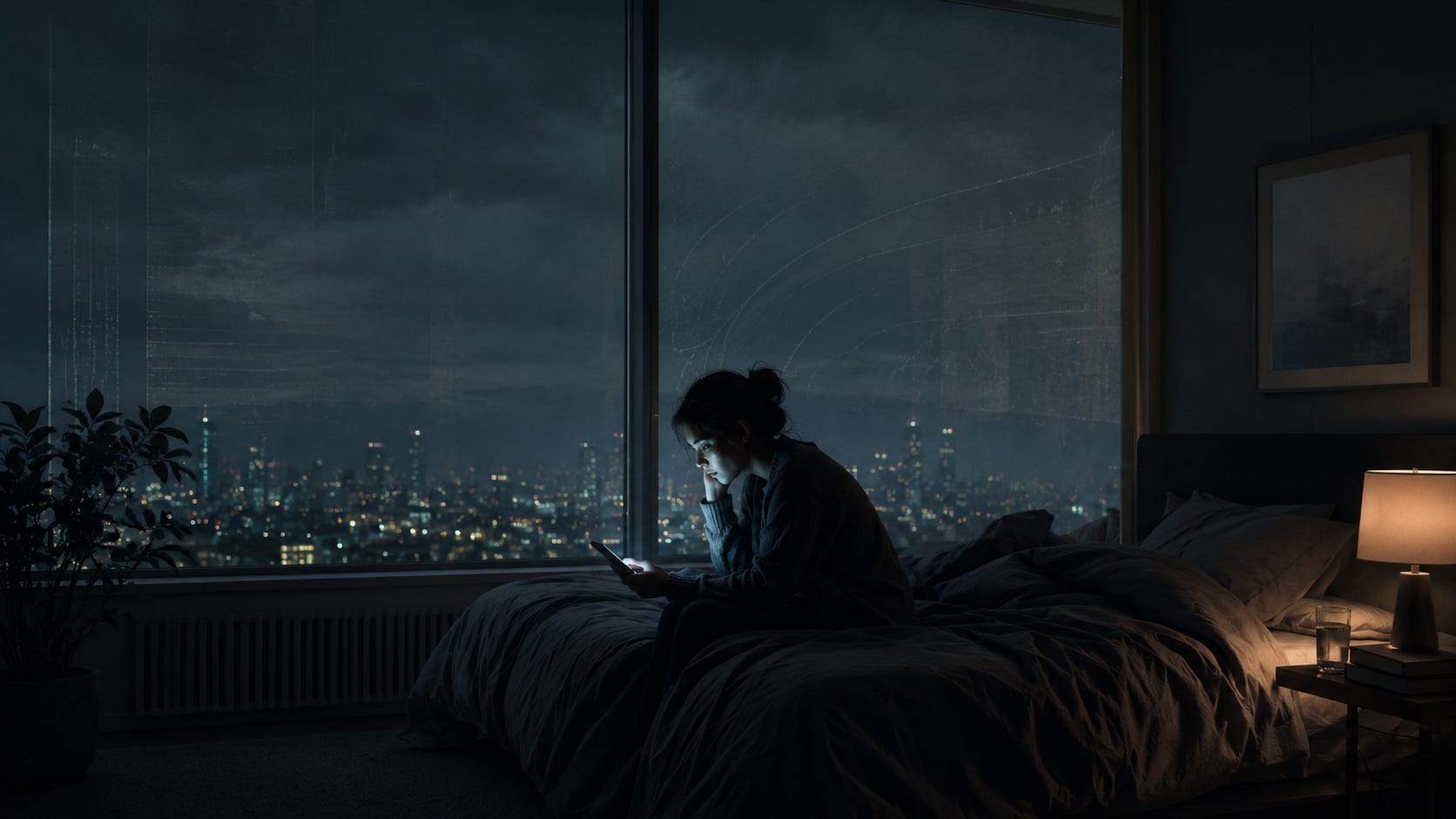
Public collapse does not knock like history.
It arrives as insomnia.
As the instinct to check the news again, then the need to avoid it entirely. As the quiet pressure behind the eyes after reading about another war, another court ruling, another democratic norm treated like optional furniture. As the strange feeling of making breakfast, answering emails, taking out the trash, paying bills, and trying to sound normal while some part of you is quietly aware that the world is behaving in ways no one has properly taught us how to metabolize.
It arrives in the body before it becomes a theory.
A tightened jaw. A shorter attention span. A background hum of dread. A sudden impatience with small talk. A private guilt about not doing enough. A second guilt about not being able to care at full intensity all the time. A third guilt about wanting, occasionally, to close every tab, mute every alert, and live for one afternoon as if history were not repeatedly malfunctioning in public.
This is one of the strangest emotional conditions: the world breaks publicly, but much of the burden is carried privately.
A court rules. A border shifts. A forest burns. An election threatens to redraw the moral weather of a country. A humanitarian disaster becomes a headline, then a clip, then a debate, then a trend, then yesterday’s content. A platform changes its algorithm. A leader says the unsayable out loud. A war enters another phase. An institution issues a statement in language so bloodless it seems designed not to disturb the furniture.
And then the feed moves on.
But inside the citizen, something remains unresolved.
It would be easy to call this anxiety. Sometimes it is anxiety. But that word can become too small for what it is being asked to hold. It suggests a private disturbance, an individual imbalance, a personal difficulty in need of better coping. It sends us toward breathing exercises, digital detoxes, productivity systems, therapy appointments, boundary-setting, and sleep hygiene. All useful, all insufficient.
Perhaps what many people are experiencing is not simply personal anxiety.
Perhaps it is the private experience of public systems failing faster than individuals can process.
Perhaps it is what happens when institutions lose trust, media loses coherence, politics loses shame, technology loses proportion, economics loses mercy, and ordinary people are still expected to remain informed, functional, kind, employable, emotionally regulated, and available for Monday morning.
We are living through a strange civic condition: too informed to be calm, too powerless to act.
1. Too informed to be calm
There was a time, or at least a civic fantasy of a time, when being informed meant knowing enough to participate responsibly in public life. You read the newspaper. You watched the evening news. You listened to the radio. You discussed events with family, colleagues, neighbors, or strangers at the café. The news had rhythms. Morning edition. Evening bulletin. Sunday paper. Weekly magazine. There were deadlines, editions, pauses, and silences.
Information arrived with some kind of container.
Now it arrives everywhere.
It arrives before we have left bed. It arrives while we are brushing our teeth. It arrives between messages from friends, advertisements for skincare, videos of cats, footage of bombed buildings, commentary about elections, jokes about collapse, influencer advice, economic warnings, weather alerts, and someone’s beautiful vacation in a country whose politics we also vaguely understand to be in trouble.
The modern person does not simply “follow the news.” The modern person lives inside a permanent stream of unresolved reality.
War is no longer distant in the old sense. We may not experience it directly, but we can watch it almost instantly. Climate breakdown is no longer a future abstraction. It appears as heat maps, floods, fires, failed crops, insurance crises, migration debates, and the eerie normalization of phrases like “once in a century” occurring every few months. Democratic erosion is no longer something historians politely explain after the fact. We can watch norms bend, institutions hesitate, language degrade, and authoritarian habits rebrand themselves as common sense in real time.
The old instruction of stay informed was built for a slower information world.
Today, staying informed can mean absorbing more crisis than any individual psyche was designed to carry. It means being asked to track wars, elections, court rulings, artificial intelligence, inflation, rights, pandemics, public scandals, ecological warnings, platform manipulation, disinformation, and the latest thing everyone is suddenly expected to have an opinion about by lunchtime.
We were told that awareness was the first step toward change. And often, it is. Awareness matters. Ignorance has never protected democracy. Looking away has never been a serious moral strategy. A society that cannot see its own suffering cannot repair it.
But awareness without orientation becomes weight.
There is a difference between knowing and being able to make meaning from what we know. There is a difference between exposure and understanding. There is a difference between receiving fragments and being given a map.
Much of contemporary information life gives us fragments.
A headline without history. A clip without context. A chart without emotional scale. A scandal without institutional memory. A tragedy without a pathway for repair. A crisis without a civic container. The result is not simply information overload. It is reality overload.
And reality overload produces strange symptoms.
People become numb because caring has lost its shape. They become cynical because sincerity feels defenseless inside a system that converts everything into performance. They avoid the news because the news has become a room with no exits. They doomscroll because the nervous system mistakes constant checking for control.
The modern citizen is not always uninformed.
Often, they are overexposed and under-equipped.
This matters because emotional life is not separate from civic life. Systems are not only experienced through policy, law, infrastructure, markets, or institutions. They are experienced through sleep, attention, trust, irritability, hope, parenting, teaching, friendship, imagination, and the capacity to believe that one’s actions still matter.
When public systems begin to feel unstable, people do not process that only as analysis. They process it as mood.
A society in crisis does not live only in parliament buildings, stock markets, ministries, or newsrooms. It lives in the stomach. In the classroom. In the family group chat. In the hesitation before opening an app. In the exhaustion of people who know enough to be worried but not enough, or not enough together, to feel capable.
This is the first half of the condition.
We are too informed to be calm.
But awareness alone is not the full wound. The deeper pain comes when awareness expands faster than agency.
2. Too powerless to act
Knowing what is wrong is not the same as having somewhere to put the knowledge.
That may be one of the quiet cruelties of the information age. More people can see how power works. More people can recognize patterns of manipulation, hypocrisy, inequality, democratic decay, ecological danger, and institutional failure. More people have access to analysis that previous generations might never have encountered. More people can name systems, read data, trace connections, and understand that isolated events are rarely isolated.
But knowing does not automatically create leverage.
A citizen can watch a war unfold, understand something about its causes, grieve the suffering, distrust the official language around it, and still have almost no meaningful way to intervene. A young person can understand the climate crisis, change personal habits, join a campaign, feel the scale of what is at stake, and still watch governments negotiate with the atmosphere as if physics were open to compromise. A worker can understand that burnout is structural, not merely personal, and still have rent due at the end of the month. A parent can understand that their child’s attention is being shaped by platforms designed for compulsion and still have to negotiate homework, school systems, peer pressure, and the impossible social politics of the smartphone.
The available responses are often tiny.
Post. Share. Donate. Vote. Sign. Mute. March. Recycle. Call. Email. Subscribe. Unsubscribe. Buy differently. Speak up. Calm down. Raise awareness. Take a break. Breathe.
None of these actions are meaningless. Many matter deeply in the right context. But placed against planetary-scale crisis, democratic erosion, war, institutional capture, economic insecurity, or algorithmic manipulation, they can feel painfully disproportionate.
The problem is the mismatch.
The world presents itself at the scale of systems. The citizen is often offered action at the scale of the individual.
That mismatch produces a particular kind of helplessness. Not the helplessness of ignorance, but the helplessness of informed spectatorship. You can see the machinery. You can hear the gears grinding. You can even predict some of the consequences. But you cannot find the lever.
Awareness expands, but leverage does not.
This is why so many people oscillate between compulsive attention and total avoidance. Between outrage and numbness. Between wanting to know everything and wanting to know nothing. Between the moral pressure to stay engaged and the emotional need to remain alive inside one’s own life.
There is also shame in this condition.
People feel ashamed that they are not doing enough. Ashamed that they are tired of caring. Ashamed that they have become desensitized to suffering. Ashamed that they still want beauty, pleasure, ambition, love, comfort, and ordinary happiness while so much of the world appears to be burning, breaking, or quietly reorganizing itself into something harsher.
But shame individualizes what may actually be a civic design problem.
A healthy society would not simply expose people to crisis and then leave them alone with their reaction. It would create pathways between awareness and agency. It would help citizens understand where power sits, what scale of action matters, how collective pressure forms, where local interventions are meaningful, and how emotional stamina is preserved over time. It would distinguish between responsibility and omnipotence. It would teach people how to care without collapsing.
Instead, much of modern life gives us permanent visibility and limited agency.
We are invited to witness almost everything and meaningfully shape almost nothing.
The cruel joke of the information age is that it made more people aware of how power works without giving them much more power to change it.
So the knowledge remains inside them active, unresolved, politically homeless.
This is the private burden of public collapse: not simply that systems are failing, but that individuals are left to metabolize the evidence alone. The headline ends. The feed moves on. The institution issues a statement. The market adjusts. The court rules. The war continues.
But inside the citizen, something remains.
Continue reading: how the feed turned citizens into witnesses, why broken systems become private anxiety, and what comes after awareness.
